Climate change, increasing urbanisation and more extreme rainfall events are placing ever greater demands on our built environment. Water retention roofs provide an effective solution by temporarily or permanently storing rainwater on the roof and releasing it in a controlled manner. This reduces peak loads on the sewer system and minimises the risk of flooding during heavy rainfall.
Depending on the application, the stored water can also be retained and made available for vegetation. This increases evapotranspiration, helps cool the surrounding environment and creates opportunities for greater biodiversity.
Catch it. Keep it. Re-use it.
Click on the sections below for more information about our water retention systems for extensive green roofs, roof gardens and trafficked roof constructions.
Water retention and water buffering complement each other. Water retention focuses on temporarily or permanently storing rainwater to reduce peak loads on the drainage system during heavy rainfall. Water buffering keeps this stored water available for longer, allowing it to be used by vegetation and to enhance evapotranspiration.
The foundation of every water retention system consists of water retention elements combined with a flow control device. By regulating the discharge in a controlled manner, both the storage capacity and discharge rate can be tailored to the specific requirements of each project.
Nophadrain offers water retention systems for a wide range of roof applications. The system build-up, compressive strength and water storage capacity are tailored to the intended use of the roof.
Pure water retention means that rainwater is temporarily stored on the roof and then discharged in a controlled and delayed manner to the sewer system or the surrounding environment. The main purpose is to reduce the load on the sewer system during heavy rainfall. The retained water can also be directed to an external water storage facility, such as a swale.
At Nophadrain, we combine water retention and water buffering for green roofs. The ND AFC-100 Adjustable Flow Control can be adjusted to determine how quickly the water is discharged, or whether it is buffered entirely on the roof. As a result, water can be buffered temporarily or permanently in the ND WSE Water Retention Elements. With permanent water buffering, the water is not discharged to the sewer system but remains safely stored on the roof. By incorporating ND KS Capillary Strips and ND KV-200 Capillary Geotextile, the stored water is transported by capillary action back into the substrate layer, where it is absorbed by the vegetation according to its water demand.
Water retention roofs temporarily store rainwater and release it in a controlled, delayed manner, significantly reducing the load on the sewer system during heavy rainfall. Green roofs take this one step further: the stored water is used by the vegetation, enabling evapotranspiration and providing additional cooling to the surrounding environment. In this way, a conventional roof becomes an active contribution to a climate-resilient city.
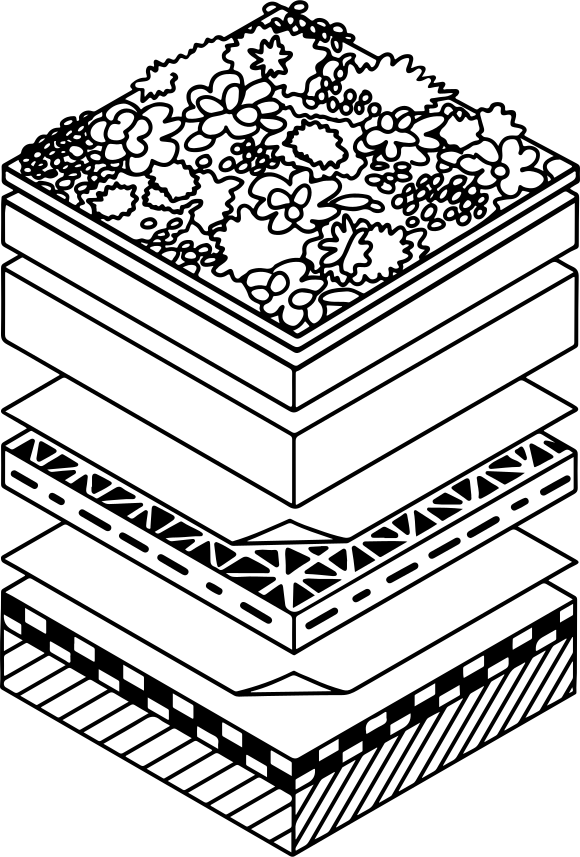
Starting from the (root-resistant) waterproofing membrane, the build-up consists of a protection geotextile, water retention element, filter geotextile, optionally ND KS Capillary Strips in combination with ND KV-200 Capillary Geotextile (replacing the standard filter geotextile), extensive substrate, and extensive vegetation, such as the ND Vegetation Blankets – Sedum.
Nophadrain systems work as follows. During rainfall, rainwater is absorbed by the substrate layer, while excess water flows into the ND WSE-80 Water Retention Elements. The ND AFC-100 Adjustable Flow Control can be adjusted to determine whether the water is buffered temporarily or permanently on the roof instead of being discharged directly to the sewer system. By using ND KS Capillary Strips together with ND KV-200 Capillary Geotextile, the stored water is transported back to the substrate layer by capillary action, where it is absorbed by the vegetation according to its water demand. This helps keep the vegetation healthy, even during prolonged dry periods.
Nophadrain systems work as follows. During rainfall, rainwater is absorbed by the substrate layer, while excess water flows into the ND WSE-50 or ND WSE-100 Water Retention Elements. The ND AC-100 Flow Control can be adjusted to determine whether the water is buffered temporarily or permanently on the roof instead of being discharged directly to the sewer system. By using ND KS Capillary Strips together with ND KV-200 Capillary Geotextile, the stored water is transported back to the substrate layer by capillary action, where it is absorbed by the vegetation according to its water demand. This helps keep the vegetation healthy, even during prolonged dry periods.
Rainwater is temporarily stored in the ND WSE-50hd or ND WSE-100hd Water Retention Elements and subsequently discharged in a controlled manner through the adjustable ND AFC-100 Flow Control. This ensures that water is released gradually to the sewer system, protects the roof against water accumulation, and prevents damage to the underlying construction caused by the washout of bedding materials
Curious about the possibilities of our innovative Nophadrain solutions for your project? Don’t wait any longer and make an appointment with one of our experts today!