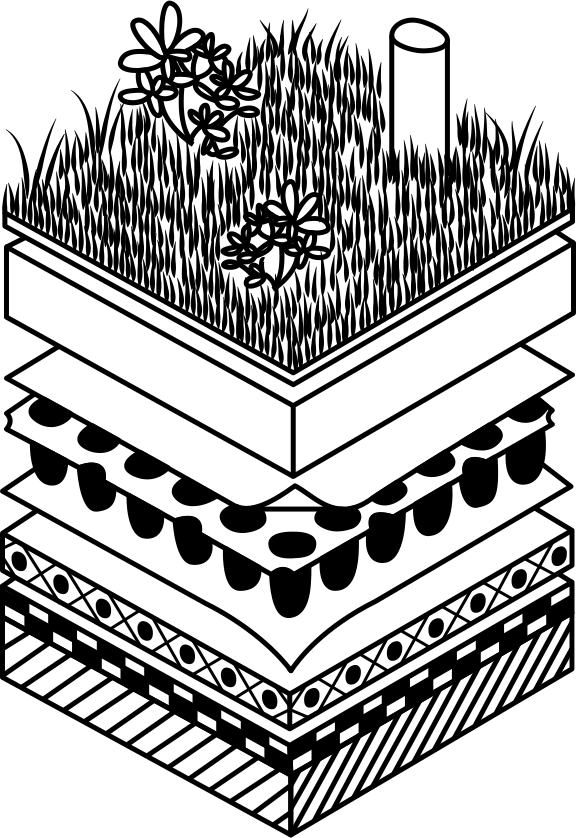
The return of nature in cities plays an important role for livable cities. With the right green roof system, almost any gray roof transforms into an extensive and even an intensive green roof.
Extensive green roofs are aesthetic, durable, lightweight and require little maintenance.
Intensive green roofs are comparable to ground-based greenery, such as gardens and park landscapes. The intensive vegetation needs more water and regular maintenance. Lawns, shrubs and trees are the most common intensive vegetation for green roofs. This vegetation is often combined with areas for pedestrian or cars.
The core of the Nophadrain systems for green roofs are the ND+1 Drainage Systems. They all have a built-in water buffer function and are suitable for both a warm and inverted roof.
Click on the blocks below for the specific systems for green roofs: extensive and intensive green roofs.
The core of the Nophadrain Green Roof Systems are the ND+1 Drainage System products. They all have a built-in water buffer function. Our ND 4+1h Drainage System is our all-round drainage system for green roofs. This multifunctional, CE marked drainage system is designed with a compressive strength of more than 600 kPa. It is equipped with a strong filter and protective geotextile, making it suitable for the highest drainage performance. It also prevents the pressure of water on the waterproofing membrane. If the roof has no or limited slope, use the ND 5+1 Drainage System with a certified drain length of up to 13 meters. We offer the right solution for every green roof.
To make even more water available for vegetation, Nophadrain recommends supplementing the substrate layer in extensive green roofs with our ND SM Substrate Panels. The substrate panels are available in two different heights and can buffer up to approx. 15 respectively 30 l/m² of water. The substrate panels allow root growth and are compression limited. Due to these special properties, they can even replace substrate and thus reduce the total weight of the green roof system. Heat island stress in the city is thus counteracted.
We recommend the ND WSM-50 Water Reservoir Panels for intensive green roof systems. They tolerate the higher weight of intensive green roofs and buffer up to 40 l/m² of water. All water reservoir panels buffer water to their saturation point. This means that more water is immediately available for vegetation. This leads to increased evaporation, supporting the small water cycle and draining only excess water to the drainage layer below. Due to their specific structure, the ND WSM-50 Water Reservoir Panels also function as an additional filter layer.
This allows the use of substrates with higher organic content, enabling an even more biodiverse vegetation with increased transpiration and evaporation. Completely in line with our motto: “Catch it, Keep it, Re-use it”.
The benefits of the Nophadrain Green Roof Systems:
There are two types of green roofs: extensive and intensive green roofs.
Extensive green roofs are generally designed to be robust, low-maintenance, durable, and lightweight. This makes this type of green roof particularly suitable for lightweight structures. With sedum, herbs, or grasses, even biodiverse habitats can be created in areas with less favorable climatic conditions.
Intensive green roofs are similar to ground-level greenery, such as gardens and park landscapes. The intensive vegetation requires more water and, consequently, regular maintenance. Lawns, shrubs, and trees are the most common types of intensive vegetation on green roofs. This vegetation is usually combined with areas for pedestrian or vehicular traffic.
Intensive green roofs are often applied on roofs that connect directly to ground level or form part of the surrounding living environment. They visually blend into the landscape and function as a fully usable outdoor space.
By combining vegetation with paving, walkways, terraces, and seating areas can be created, allowing the roof to be used safely and comfortably by residents, visitors, or the public. Paving also provides clear spatial organization, improves accessibility, and protects the planting from intensive use.
Nophadrain provides advice from the preliminary design and detailed design phases onward, including detail drawings, specification texts, and technical guidance during construction. This ensures that every green roof is optimally designed and installed using the Nophadrain Green Roof System.
For extensive green roofs, suitable insulation options include XPS in an inverted roof construction or cellular glass in a warm roof construction. Inverted roofs with XPS require a damp-permeable drainage layer on top to allow the insulation to dry and minimize condensation, while warm roofs with cellular glass provide full bonding with the deck and waterproofing for added stability and protection.
For intensive green roofs, recommended insulation options are XPS in an inverted roof construction or cellular glass in a warm roof construction. Inverted roofs with XPS require a damp-permeable drainage layer to allow drying and minimize condensation, while warm roofs with cellular glass provide full bonding with the deck and waterproofing, ensuring durability and load-bearing capacity.
Waterproofing under both extensive and intensive green roofs must be watertight and root-resistant, able to withstand rhizomes from cultivated grasses, and preferably CE-marked or certified. Closed systems can be sheet membranes, liquid-applied, or mastic asphalt. For intensive green roofs, fully bonded waterproofing is recommended for extra protection against leaks, especially on insulated roofs. Extensive green roofs can also use loose-laid or mechanically fixed systems, provided root resistance and watertightness are ensured.
The roof edge should extend at least 150 mm above the vegetation layer or paving. If the available height is insufficient, a roof edge profile can be installed to safely retain the green roof system.
The waterproofing membrane should be extended at least 150 mm above the vegetation layer. If door thresholds are low, an emergency overflow must be installed. Around façade connections, a vegetation-free and walkable strip of gravel or paving is applied, separated from the vegetation by an edge retaining profile.
Roof upstands such as skylights, ventilation units, and flues should be at least 50 mm higher than the roof edge. A vegetation-free zone of gravel or paving should be installed around these elements, separated from the vegetation by an edge retaining profile.
Adequate roof slope ensures proper drainage of rainwater and prevents long-term ponding. For both types of green roofs, ponding may occur on a maximum of 5% of the roof area, with a maximum depth of 5 mm. For intensive green roofs, a proper slope is even more important, as heavier vegetation and deeper substrate layers can more easily lead to water accumulation and saturation of the vegetation layer.
For both extensive and intensive green roofs, drainage systems such as ND 5+1 or ND 6+1v prevent the vegetation layer from coming into direct contact with standing water. These systems effectively raise the vegetation layer about 27 mm above the water level. For intensive green roofs this is particularly important, as thicker substrate layers can retain more water and therefore increase the risk of ponding.
For extensive green roofs, a minimum effective roof slope of 1% is recommended (2% for single-layer systems). Intensive green roofs also require at least 1%, but structural engineers must account for the higher weight of the system and possible deflection of the structure. In practice, a slightly greater slope may therefore be required to prevent water accumulation.
For roof slopes from 15° onwards, structural and vegetation-related measures must be applied, such as anti-slip provisions, drainage systems, erosion protection, anchoring of the vegetation layer, and the use of reinforced vegetation mats or geocomposites.
Green roofs are generally not recommended on roofs with slopes greater than 45°, as the technical and vegetation-related challenges become too great to ensure a stable vegetation layer.
The build-up of an extensive green roof consists of the following layers, each with its own specific function: a root-resistant layer, separation and protection layer, drainage layer, filter layer, growing medium layer and vegetation layer.
Each layer has a specific role. Together they create a durable base for vegetation on the roof. Some products, such as ND Drainage Systems, can perform multiple functions at the same time.
A root barrier layer is required when the waterproofing system of the roof is not root resistant. Root-resistant waterproofing membranes include materials such as PVC, EPDM, or bitumen with a special root-resistant finish, tested in accordance with DIN 4062-1 or the FLL root penetration test / EN 13948. For non-root-resistant roofs, the ND WSB-50 Root Barrier (for extensive green roofs) or ND WSB-80 Root Barrier (for intensive green roofs) can be used. A watertight concrete roof does not require a separate root barrier layer.
The root barrier must be heat-welded at the overlaps and should be extended at least 120 mm above the vegetation substrate layer at façade connections, roof edges, and upstands. In an inverted roof construction with a non-root-resistant waterproofing system, the separate root barrier should be installed directly beneath the thermal insulation, on top of the waterproofing membrane. Examples include the ND WSB-50 (extensive green roofs, 0.5 mm) and ND WSB-80 (intensive green roofs, 0.8 mm).
A separation and protection layer prevents materials that are chemically incompatible from coming into contact and protects the waterproofing system from mechanical and dynamic loads during installation and use.
In Nophadrain systems for extensive green roofs, the bottom layer of the ND Drainage Systems performs this function. For intensive green roofs, a slip layer is often used, such as the ND TSF-100 Slip and Protection Sheet in combination with the ND Drainage System. This slip layer ensures that dynamic loads from the overlying layers are not transferred to the waterproofing, keeping the roof safely and durably protected.
The drainage layer, together with the filter layer, forms the drainage system of a green roof. It collects excess water from the vegetation substrate layer and channels it in a controlled way to the roof drains. This prevents water accumulation and protects the waterproofing system from water pressure.
A drainage layer should have good vertical permeability, high horizontal water drainage capacity, and long-term creep resistance (up to 50 years). Its drainage capacity is designed according to the roof slope and expected load and must comply with DIN 4095 (“Drainage of buildings”: rainfall intensity 0.03 l/(s·m²)).
The filter layer prevents fine substrate particles from the growing medium layer from entering the drainage layer. This ensures optimal horizontal water drainage and prevents clogging of the drainage system.
ND Drainage Systems are CE-marked sandwich elements that combine a filter, drainage and protection layer in a single product. They drain excess water, prevent clogging, and protect the waterproofing membrane. Types such as 4+1h, 5+1, and 6+1v also include an additional water reservoir for the vegetation. Thanks to their perforated construction, these systems are also suitable for inverted roofs, allowing thermal XPS insulation to dry and minimizing internal condensation.
All ND Drainage Systems are delivered as a single integrated product on a roll, with the filter, drainage, and (slip and) protective layers bonded together. This makes them easy to handle and quick to install.
A high compressive strength is essential to prevent damage to the drainage system, especially during the installation phase. During installation, installers regularly walk on the roof, which temporarily places heavy loads on the system.
If the drainage system does not have sufficient compressive strength, the dimples may dent or become damaged. This can negatively affect the water drainage and the overall performance of the green roof.
Nophadrain supplies drainage systems with high compressive strength, manufactured from HIPS (High Impact Polystyrene). This ensures that the dimples remain intact during installation and that the functionality of the green roof is maintained.
Sometimes, yes. It depends on the build-up height. At Nophadrain, we recommend using the ND WSM-50 Water Reservoir Panels. These panels buffer approximately 40 l/m² of water and deliver it directly to the plants through capillary action. This keeps the substrate moist, prevents excessive water pressure on the roof, and allows a lower substrate layer to be applied, saving weight. The panels regulate water naturally, only draining excess water when fully saturated, and they also act as an additional filter, making it safe to use topsoil.
For extensive roofs, the ND SM-25 and ND SM-50 Substrate Panels are used. These panels do not provide an extra filtration function, which is unnecessary since the use of topsoil is not relevant for extensive green roofs.
The growing medium layer forms the foundation for the vegetation. It must be able to retain water and make it available to the vegetation, support intensive root penetration, drain excess water to the underlying drainage layer, and have a stable, shear-resistant structure. The growing medium layer consists of roof garden substrate, roof soil, or substrate-replacing panels.
On extensive roofs, the growing medium layer can consist of loose substrate or substrate substitutes. Loose substrate contains a maximum of 65 g/l of organic components and complies with the FLL Green Roof Guidelines (2018). At Nophadrain, substrate substitutes are the ND SM-25 or ND SM-50 Substrate Panels. These panels are entirely mineral-based, dimensionally stable, lightweight, and have a high water-retention capacity, making them suitable for lightweight roof constructions and sloped roofs.
The layer thickness depends on the chosen vegetation, roof slope, climatic conditions, roof orientation, maximum roof load, and the desired water-retention capacity.
For extensive green roofs:
For intensive green roofs:
On intensive green roofs, two primary types of growing medium layers are commonly applied: substrate and suitable topsoil. All layers comply with the FLL Green Roof Guidelines (2008) and are tailored to meet vegetation requirements, including adequate rooting space, water availability, and nutrient supply.
The intensive substrate consists of a mixture of mineral and organic components. It is designed to retain water, provide nutrients, and protect the underlying filter and drainage layers. For intensive vegetation, the substrate may contain up to a maximum of 90 g/l of organic material. When the growing medium layer is sufficiently thick, a mineral substrate can be used as a lower (base) layer beneath the intensive substrate.
Suitable topsoil may also be used in combination with ND WSM-50 Water Reservoir Panels, as these panels provide an additional filtering function.
On extensive green roofs, plants are chosen for their resilience to extreme weather conditions. Typical combinations include moss–sedum, sedum–moss–herbs, sedum–herbs–grasses, and grasses–herbs. Locally occurring or native species are preferred.
The choice of vegetation depends on climatic factors (e.g. sun exposure, drought, rainfall, and wind direction), structural factors (e.g. roof orientation, slope, shading, and wind flow) and vegetation-technical factors (e.g. winter hardiness, wind resistance, requirements for the vegetation-bearing layer, and competition tolerance). These conditions together determine the success and durability of the roof vegetation.
Vegetation can be applied as sedum cuttings, plug plants, or vegetation blankets. Sedum cuttings are scattered and lightly rolled in, plug plants are planted in a minimum layer thickness of 60 mm, and vegetation blankets are rolled out with at least 25 mm overlap to ensure full coverage.
On an intensive green roof, almost any type of vegetation can grow, ranging from lawns and low plants to tall trees up to 15 m, depending on the structural possibilities and the required rootable space.
The vegetation layer can be locally raised using planting boxes or substrate mounds to create sufficient root space. For additional stability and protection against wind, steel reinforcement mats can be incorporated into the vegetation layer.
An extensive green roof requires maintenance 1–2 times a year, preferably in spring and autumn, including the following tasks:
Nophadrain provides detailed maintenance instructions on this website.
Curious about the possibilities of our innovative Nophadrain solutions for your project? Don’t wait any longer and make an appointment with one of our experts today!