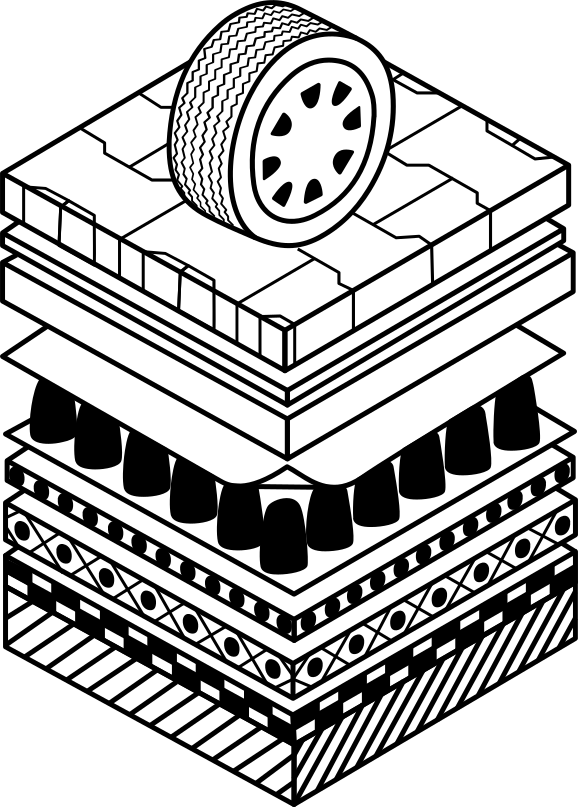
With our trafficable roof systems, we transform gray roofs of underground structures and parking garages into walkable and trafficable public space.
To prevent structural damage to a paved area on the roof, it is important that the drainage system is strong and designed to withstand mechanical loads as well as the impact of water. Poor drainage and insufficient slope can lead to water stagnation on the roof. This can destabilize the subsurface and soil layers, cause frost damage to the paving or cause unwanted hydrostatic pressure on the waterproofing membrane. Therefore, a reliable and suitable drainage system is essential for the design of trafficable roofs.
The core of the Nophadrain Trafficable Roof Systems consists of the drainage systems from the ND 200 series (walkable roofs) and the ND 600 series (trafficable roofs).
Click on the blocks below for the specific systems for trafficable roofs: walkable roofs, trafficable roofs for cars and trafficable roofs for heavy goods vehicles.
The drainage systems of the ND 200 series, such as the ND 220 and ND 200sv Drainage Systems, have a compressive strength of 700 kPa and always consist of three functional layers that come together in one product: a filter layer, a drainage layer and a protective layer. However, the real powerhouses are the drainage systems from our ND 600 series, such as the ND 620 and ND 600hdsv Drainage Systems. Drainage cores with extremely high compressive strengths of approximately 900 kPa or even 1,200 kPa characterize them. This makes them suitable for load classes N1, N2 and N3.
In addition to excellent compressive strength, all drainage systems of the ND 600 series are equipped with a special CE-marked monofilament filter geotextile. This geotextile combines high puncture resistance with minimal stretch, so that the static and dynamic loads released during traffic activities do not cause damage to the filter layer. This also applies during installation work, such as vibrating the foundation layer with a vibrating plate. The filter fabric won’t be damaged, so the drainage layer cannot become clogged and drainage capacity is guaranteed.
The strength and stability of this series of drainage systems has proven itself not only in numerous projects, but also in long-term tests at various institutes such as the University of Munich.
The benefits of the Nophadrain Trafficable Roof Systems:
Traffic(able) roofs are roofs designed to be walkable or drivable. This means they are not only waterproof but also structurally engineered to withstand loads from pedestrians, bicycles, or even cars. The roof therefore functions as a usable surface and become accessible roofs.
With the Nophadrain Trafficable Roof Systems, we make this possible in a safe and sustainable way. By smartly combining innovative and high-quality products, we create a thin and efficiently constructed system that delivers maximum performance.
There are specialized systems, such as the Nophadrain Water Retention System for trafficable roofs, that allow water retention and drivable paving to be effectively combined.
Trafficable roofs can be effectively combined with vegetation (usually with intensive green roofs). A key requirement is that the roof waterproofing system is root-resistant or a separate root barrier should be placed directly on top of the waterproofing membrane. Root resistance must be in accordance with the DIN 4062-1 test) or hEN 13948 Flexible sheets for waterproofing.
At Nophadrain, trafficable roof systems are classified into three load classes: walkable roofs (class 1), drivable roofs for cars (class 2), and drivable roofs for heavy traffic, such as trucks (class 3). The most suitable system also depends on the available construction height, the type of paving, and any combinations with vegetation and/or water retention.
We provide guidance from the preliminary design and detailed design phases, including detailed drawings, specification texts, and technical support during installation. This ensures that every trafficable roof is optimally designed and executed using the Nophadrain Trafficable Roof System.
The main challenge is often the limited construction height of the roof. However, Nophadrain offers slim yet high-performance drainage systems, allowing even compact trafficable roofs to remain durable and strong.
Yes, all drivable systems have undergone dynamic load testing at the Technical University of Munich (TU München). During these tests, the full roof assembly is subjected to moving loads to evaluate functionality and durability, ensuring the system can withstand long-term and repeated traffic loads.
There are no specific legal requirements for the roof slope, but it is recommended to maintain an effective slope of at least 1% to ensure proper water drainage. The exact slope should be calculated by the structural engineer, taking into account deflection and construction tolerances.
Yes, small amounts of standing water are acceptable. Up to 5% of the roof surface may have ponding, spread over multiple puddles, with a maximum depth of 5 mm.
Stormwater on a trafficable roof is drained through roof outlets, inspection chambers with gully top gratings, or linear drainage channels, all of which direct the collected water to either a gravity drainage system inside or outside the building, or over the roof edge. The system must be designed to discharge both surface water from the paving and any water penetrating the paving joints, without requiring additional pressure or attenuation.
The structural engineer or designer is responsible for calculating and sizing the roof outlets, drainage channels, and associated components, ensuring they meet the relevant standards and can handle the expected loads and water volumes.
An elemental paving comprises the layers: separation layer, slip layer, protection layer, drainage layer, filter layer, sub-base layer, leveling layer, laying course, and the paving elements themselves. Each layer has a specific function, and together they create a structurally stable and durable construction capable of withstanding both static and dynamic (traffic) loads. Some products, such as ND Drainage Systems, can fulfill multiple functions simultaneously.
A separation layer is required when the materials used are chemically incompatible, to prevent harmful reactions. It is also often applied as additional protection for the roof during and after installation. Suitable materials include plastic sheets, synthetic membranes, or (depending on the type) a pressure-dividing slip film or separation geotextile from the ND Drainage System.
The slip layer prevents vertical and horizontal forces that are caused by compaction, braking, acceleration, and turning of vehicles, from being transmitted to the waterproofing membrane. This prevents damage to the waterproofing membrane.
In walkable / accessible systems (load class 1), the slip layer consists of ND TGF-20 Separation and Slip Film and the pressure-dividing slip film of the specific ND Drainage System. In drivable systems (load classes 2 and 3), the slip layer is made up of ND TSF-100 Slip and Protection Sheet and the pressure-dividing slip film of the specific ND Drainage System. For inverted roofs, two layers of ND TGF-20 Separation and Slip Film are installed beneath the XPS insulation.
The filter layer prevents fine particles from the paving or base layer from entering the drainage layer, ensuring proper horizontal water flow is maintained. Depending on the type of pavement, woven or non-woven geotextiles are used, with minimum overlaps of 100 mm and upturned edges along the perimeter to prevent washout.
The monofilament woven geotextile of the ND 600 series combines high puncture resistance with minimal stretch, making it resistant to both static and dynamic loads from traffic. This also applies during installation, as the filter can withstand the stresses of mechanical or dynamic compression of the base layer caused by a vibrating plate. As a result, the filter remains intact, keeping the drainage layer free of infill material. Thanks to these properties, this drainage system is suitable for the installation of walkable and drivable surfaces on base layers of loose fill or drainage concrete.
The drainage layer collects excess water from the pavement structure and directs it to roof outlets or over the roof edge. This prevents water buildup in the base or paving layers and protects the underlying layers. The layer must be permeable both horizontally and vertically, have high creep resistance, and comply with DIN 4095 and must be CE-marked according to hEN 13252.
A high compressive strength of the drainage core is important for drivable roofs. It ensures that the drainage system maintains its shape and original composition height, even under heavy and dynamic loads, guaranteeing reliable water drainage. Depending on the type, ND Drainage Systems for drivable roofs have a compressive strength of approximately 900 or 1,200 kPa.
The protective layer shields the roof waterproofing system from vertical loads (both mechanical and dynamic) during installation and use. For light loads (class 1), the ND Drainage System can fulfill this function. For heavier loads, additional geotextiles, foils, or concrete layers are required. Overlapping protective layers should have a minimum overlap of 100 mm and creep no more than 5% (max. 2 mm).
Depending on the design, intended use, and overall roof construction, different drainage systems can be selected for trafficable roofs. In general, they can be classified as follows:
The drainage systems of the ND 200 series, such as the ND 220 and ND 200sv Drainage Systems, have a compressive strength of 700 kPa and always consist of three functional layers that come together in one product: a filter layer, a drainage layer and a protective layer. However, the real powerhouses are the drainage systems from our ND 600 series, such as the ND 620 and ND 600hdsv Drainage Systems. Drainage cores with extremely high compressive strengths of approximately 900 kPa or even 1,200 kPa characterize them. This makes them suitable for load classes N1, N2 and N3.
ND Drainage Systems are CE-marked sandwich elements that combine a filter layer, drainage layer, and one slip layer. Depending on the type, they can also function as a separation and protective layer and be part of the slip layer. For inverted roofs, vapor-permeable types allow the XPS insulation to dry, minimizing internal condensation.
All ND Drainage Systems are delivered as a single integrated product on a roll, with the filter, drainage, and (slip and) protective layers bonded together. This makes them easy to handle and quick to install.
The capacity depends on the type of pavement and the amount of precipitation flowing through the paving (2nd discharge level) and through the joints into the drainage layer (1st discharge level). It is calculated using two formulas, which are explained in the brochure “Designing the Drainage Layer”.
The sub-base layer transfers and distributes loads, preventing deformation of the pavement. For load classes 2 and 3, a structural sub-base layer is required, except for applications using large-format concrete slabs. For class 1, a leveling or bedding layer directly on the ND Drainage System is sufficient.
A proper roof construction contributes to the stability, safety, and lifespan of the traffic roof.
The base layer must absorb both static and dynamic loads and transfer them to the underlying layers. More information can be found in the ‘Trafficable Roofs System Brochure’.
A levelling layer is needed to compensate for height differences and to create slopes in the pavement. For height differences up to 150 mm, a layer of crushed natural stone with a grain size of 2/8–3/9 mm is used (layer thickness 50–150 mm), which can also serve as the bedding layer. For greater height differences (>150 mm), the levelling layer is made of crushed natural stone with a grain size of 2/22 mm, with a separate bedding layer of 2/8–3/9 mm placed on top for the paving. The levelling layer is installed directly on the ND Drainage System, and the layers can be compacted once in place.
The laying course ensures that small size variations and irregularities in the sub-base layer are evened out, so that the pavement remains firm and stable.
The bedding layer is typically 30 – 50 mm thick and consists of crushed sand or natural stone grit. For drivable pavements, 1/3 grit is often used to improve drainage and stability. The bedding layer is not compacted; after the pavement is installed, the joints are filled, and the entire surface is vibrated or compacted. For large-format concrete slabs, a thicker layer of coarser material, such as 2/5 grit, may be required.
On roofs and decks, asphalt or concrete is generally not used; instead, elemental paving is laid on an unbound layer of base material. This provides access to the roof structure, maintains continuity with the surrounding streetscape or environment, and protects the roofing system from permanent, variable, and dynamic loads by properly distributing the forces.
Elemental pavements are permeable and consist of individual prefabricated units, such as concrete blocks, pavers, concrete tiles, or natural stone. They are mainly used in areas with slow traffic or where high pressure is applied to the underlying layer.
Rainwater should be drained as efficiently as possible across the surface to minimize penetration into the underlying layers. Therefore, pavements are installed with a slope. For walkable elemental pavements, a minimum slope of 2 % is required, and for drivable pavements, a minimum slope of 2.5 %.
More info can be found in the Nophadrain ‘System brochure for trafficable roofs‘.
For walkable pavements, almost any type of paving element can be used. For drivable pavements (class 2), concrete pavers, profiled blocks (such as H-shaped), or large-format concrete slabs are commonly applied due to their dimensional stability, slip resistance, strength, and cost-effectiveness. Profiled blocks are suitable for areas with frequent braking, turning, and heavy traffic (class 3), while large-format concrete slabs are preferred in curves, slopes, or areas with limited construction height to ensure better load distribution.
A drainage layer under the pavement prevents water from accumulating in the subbase. Without proper drainage, the subbase can become saturated and weakened, leading to settling and damage to the pavement. By controlling water discharge, the structural bearing capacity is maintained, and the lifespan of the pavement is significantly extended.
It is important to limit permanent deformation (rutting). The dimensional stability of the paving elements affects both the joint width and the transfer of forces between the stones. The suitability of the pavements is best to be proven by the manufacturer.
Curious about the possibilities of our innovative Nophadrain solutions for your project? Don’t wait any longer and make an appointment with one of our experts today!